
Technique Guide
Gentle Eye Exercises: Safe, Strain-Free Techniques
Eye exercises should always feel restorative and effortless. Rapid eye rolling, forcing your gaze past comfortable limits, or rubbing your eyes vigorously can cause irritation or dizziness. The movements described below are gentle, subtle, and require no physical contact with the eyeballs.

1. Conscious Slow Blinking (The Reset Exercise)
Prolonged screen viewing leads to "partial blinks," where the upper eyelid does not make full contact with the lower eyelid. This leaves the lower third of your cornea exposed and dry.
10
Reps
Execution Steps
1. Close both eyelids gently without squeezing your facial muscles.
2. Hold closed for two full seconds (count "one-one-thousand, two-one-thousand").
3. Open your eyes softly into a neutral gaze.
4. Repeat 10 times in a slow, rhythmic cadence.
2. The Four-Way Directional Sweep
This gentle movement engages the six extraocular muscles responsible for eye tracking, encouraging healthy circulation without straining the optic nerve.
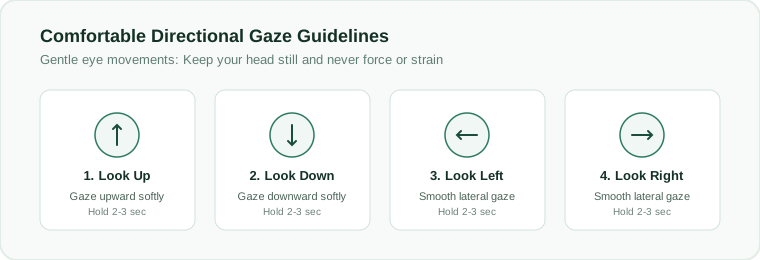
- Upward Gaze: Look gently upward toward the ceiling line for 2–3 seconds. Return to center.
- Downward Gaze: Look downward toward your desk or floor for 2–3 seconds. Return to center.
- Left Gaze: Sweep your eyes smoothly to the left for 2–3 seconds. Return to center.
- Right Gaze: Sweep your eyes smoothly to the right for 2–3 seconds. Return to center.
3. Near-to-Far Focus Shift (Accommodation Flex)
Holding a static focal length for hours causes accommodation lock, where distant objects momentarily appear blurred after looking away from a phone or notebook.
Hold your thumb or a pen roughly 10 inches in front of your face. Focus on the tip for 3 seconds. Then look past your thumb to an object at the opposite end of the room (or out a window) for 5 seconds. Repeat 5 times smoothly.
4. Warm Hand Palming (Sensory Rest)
Palming provides complete light deprivation and gentle warmth, which relaxes the parasympathetic nervous system and gives photopigments in the retina a chance to recharge.
- Wash your hands with soap and water to ensure strict cleanliness.
- Vigorously rub your palms together until warm.
- Cup your palms lightly over your closed eye sockets, resting your palms on your cheekbones and fingers on your forehead.
- Ensure no pressure touches your eyeballs. Breathe slowly in through the nose and out through the mouth for 60 seconds.
Safety Notice on Eye Pressure
Never press down on your eyeballs with your fingers, knuckles, or palms. Increased mechanical pressure on the globe can cause transient visual distortions or harm corneal curvature. Keep all touch feather-light and focused strictly on the surrounding facial bones.